Berlin Science Week 2026
Ancestral algorithms: How did rural women end up weaving eDNA into a tapestry in remote Patagonia?
November 8, 2026 · Berlin
How does knowledge return to a community: through data—or through culture? Before biodiversity became data, the community of Raúl Marín Balmaceda had long observed the marine life around them. Environmental DNA research later added another layer of evidence to that knowledge, revealing how life leaves traces in water. But once those traces became scientific information, another question emerged: how could that knowledge return in a form that could be understood, felt, and held close to the heart of its culture?
In this talk, Michelle Lezana brings a linguist’s perspective to how information moves through systems of inscription: the codes that make data legible, the languages that make it shareable, and the surfaces that allow knowledge to be carried, touched, and returned.
In Touch
A different way of being in touch with science.
Berlin Science Week’s 2026 theme, In Touch, asks how knowledge meets the world. This talk answers through material form: what if ancestral technologies can make new scientific knowledge understandable in ways a graph, paper, or dataset cannot? When knowledge can be carried, touched, and returned, science becomes something a community can hold close to the heart of its culture.
The speaker
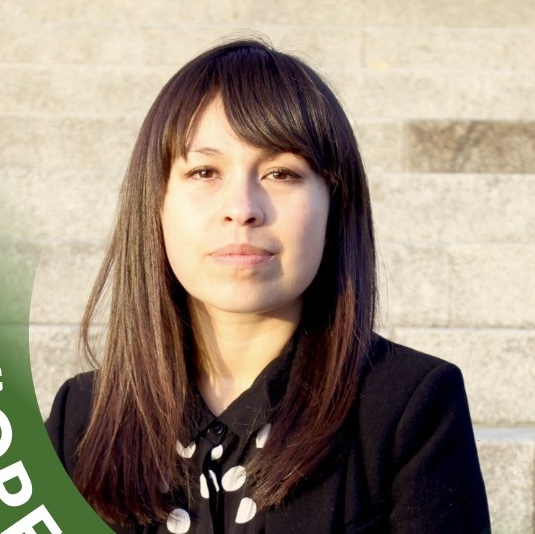
Michelle Lezana
Director, Institute for Wild Futures
Michelle Lezana is a linguist and science communication specialist from Chile, working across academia, public institutions, culture, and public policy, with particular attention to remote territories such as Patagonia.
Event information
- November 8, 2026
- 18:45–19:00 · Michelle Lezana
- 19:00–19:20 · Meet the Scientists
- Inspiration Stage: Hidden Worlds
- Angie Stardust Foyer · Haus der Kulturen der Welt
- John-Foster-Dulles-Allee 10, 10557 Berlin, Germany
- English
- Free entry · 3-Day Festival Centre Pass required
Context
Part of Inspiration Stage: Hidden Worlds.
Michelle’s talk forms part of Inspiration Stage: Hidden Worlds, a programme block exploring the connections between people and place and the hidden systems, histories, and relationships that shape the world we share. Spanning water research, urban ecology, environmental health, and art-science practices, the block looks at moments when what is hidden becomes visible and legible — with Michelle bringing the perspective of remote Patagonia.
Continue the conversation in Berlin.
If you are working on research translation, territorial knowledge, or public-interest science, we would like to meet.
Or email us directly at iwf@instituteforwildfutures.com